
Notifications

Site Tour with Test Users
Choose a test user to login and take a site tour.
Choose a test user to login and take a site tour.


7 minutes, 34 seconds
-2 Views 0 Comments 0 Likes 0 Reviews
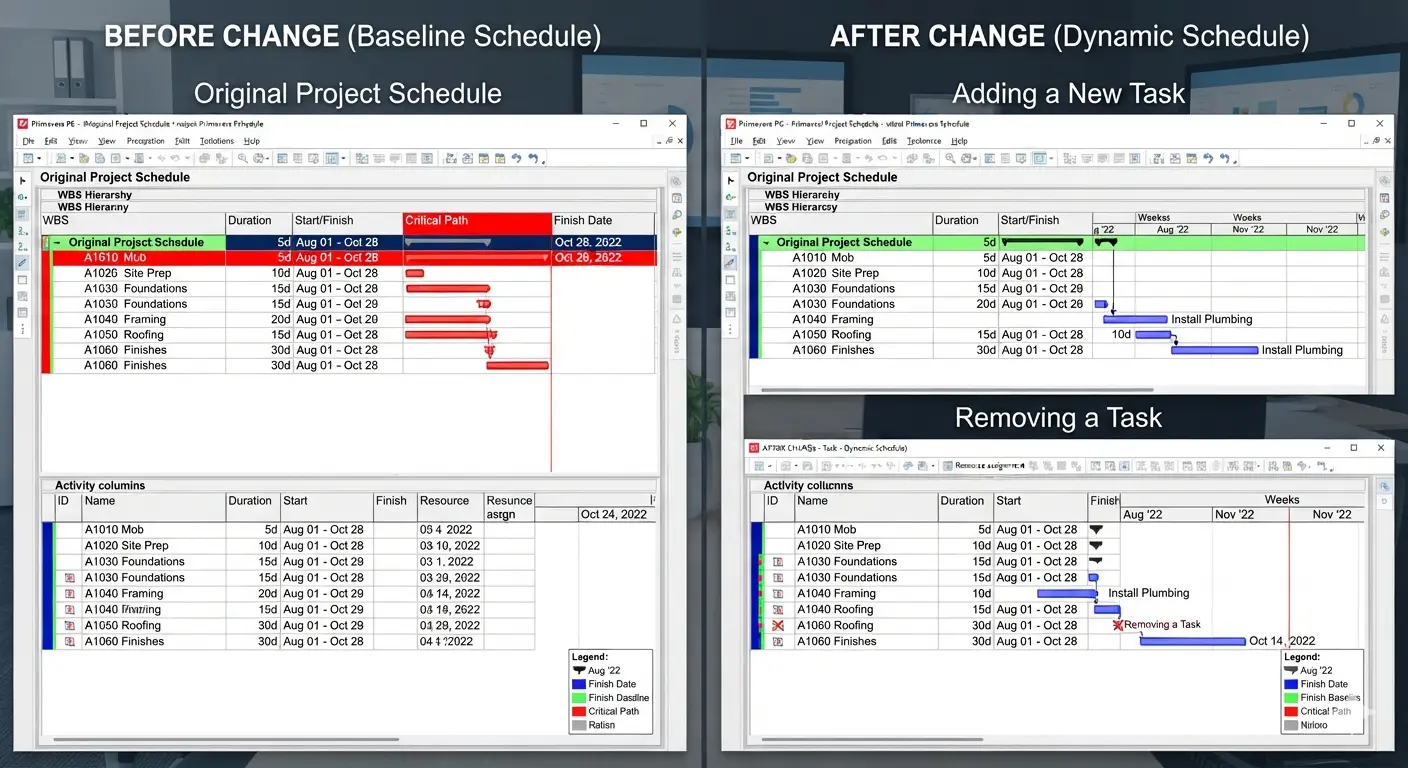
Adding or removing a task in Primavera P6 involves many things other than just changing the activities themselves. Adding or removing a task will also affect dates, links, float, critical path, resource allocation, cost, and milestone. After every structure changes, the scheduling engine re-computes the network. This is one of the important topics to cover in a Primavera P6 Course because every change creates a new calculation.
Important Points to Remember
Adding a new activity changes the critical path.
Deleting an activity changes the logic of the schedule.
Float will increase, decrease or even go away.
Changing calendars may affect the duration of the task.
Resources or cost may change without changing the finish date.
The baseline will not change with the current schedule.
When a new activity is added, P6 creates a place for it in the schedule. The real effect starts when relationships are assigned. If the task is linked between two activities with a Finish-to-Start relationship, the successor must wait for the new task.
P6 also uses the activity calendar to calculate working dates. A five-day duration does not always mean five normal calendar days.
After adding a task, check its predecessor, successor, duration, calendar, constraints, resources, float, and logic carefully.
When the schedule is run, P6 performs date calculations through the network. Early dates move forward through the network. Late dates are calculated backward.
If a task is inserted into a chain, the next activity may move. But the whole project does not always move. Available floats can absorb the added duration.
This is an important point in Primavera P6 Training in Noida. Noida has engineering and project-support teams where schedule updates must be checked through logic and dates.
A task can be added without a predecessor or successor. It may still appear correctly, but it may not control other work. A planner should check missing relationships and review schedule diagnostics after structural changes.
Task Dependent activities follow their assigned calendar. Resource-dependent activities can behave differently. Constraints can also stop dates from moving freely.
Deleting an activity is not like deleting a spreadsheet row. It may contain relationships, resources, expenses, codes, progress, notes, and dates.
If one activity sits between two others, removing it may leave the remaining activities without the correct relationship. The successor could then move earlier than expected.
The project may appear shorter after deletion. This may mean the schedule no longer contains the deleted work.
P6 supports Finish-to-Start, Start-to-Start, Finish-to-Finish, and Start-to-Finish relationships. Each type produces a different date result.
If a task is inserted into a Finish-to-Start chain, it creates another waiting point. With Start-to-Start, another activity may begin before the new task finishes. Lag can add another time gap.
This is why Primavera P6 Training Institute in Delhi can be useful for learners who want to understand schedule logic.
Total Float indicates the amount of shift in the schedule for an activity before impacting any of the late dates associated with schedule settings.
Introduction of an activity will use up the remaining float. If the float equals zero, the path may become critical. Elimination of an activity will free the float or make another path as critical. This depends upon the existing network, durations, calendars, constraints, progress, and calculation settings.
Activities can contain labor, equipment, material, and expense assignments. Adding a task can increase resource demand even when the project finish does not change. The schedule may finish on time while a team or machine becomes over-allocated.
Costs can change too. Removing an activity may reduce planned cost in the current schedule, but real project cost does not disappear just because the activity was deleted.
If the current finish date changes, the approved baseline does not automatically change. Deleting an activity that already contains progress needs extra care. It can affect reports, earned value calculations, variance analysis, and management views. Record the change, run the calculation, and compare the result with the approved plan.
After adding or removing a task, use a short review.
|
Check |
What to review |
|
Logic |
Predecessors and successors |
|
Dates |
Start and finish dates |
|
Float |
Total Float and critical path |
|
Calendar |
Workdays, holidays, shifts |
|
Resources |
Demand and over-allocation |
|
Cost |
Planned values |
|
Baseline |
Current versus approved dates |
|
Progress |
Actual and remaining duration |
This review teaches learners to read the schedule as a connected network.
Before deleting a task, inspect relationships, resources, progress, and cost. Before adding one, decide its place in the work breakdown structure and network.
After the change, run the schedule and compare it carefully with the previous version and approved dates. Check project finish, milestones, critical path, float, resources, and constraints.
Adding or removing a task in Primavera P6 changes more than the activity count. It can change network logic, dates, float, critical paths, resources, costs, milestones, and reports. P6 calculates these results from relationships, calendars, durations, constraints, and progress. A planner should run the schedule after every structural change and inspect the result carefully. The key rule is simple: never judge a change only by the final finish date. Check which relationship caused the movement, which path changed, how much float was used, and whether the updated schedule still represents the real project work. That makes the schedule more reliable.


